

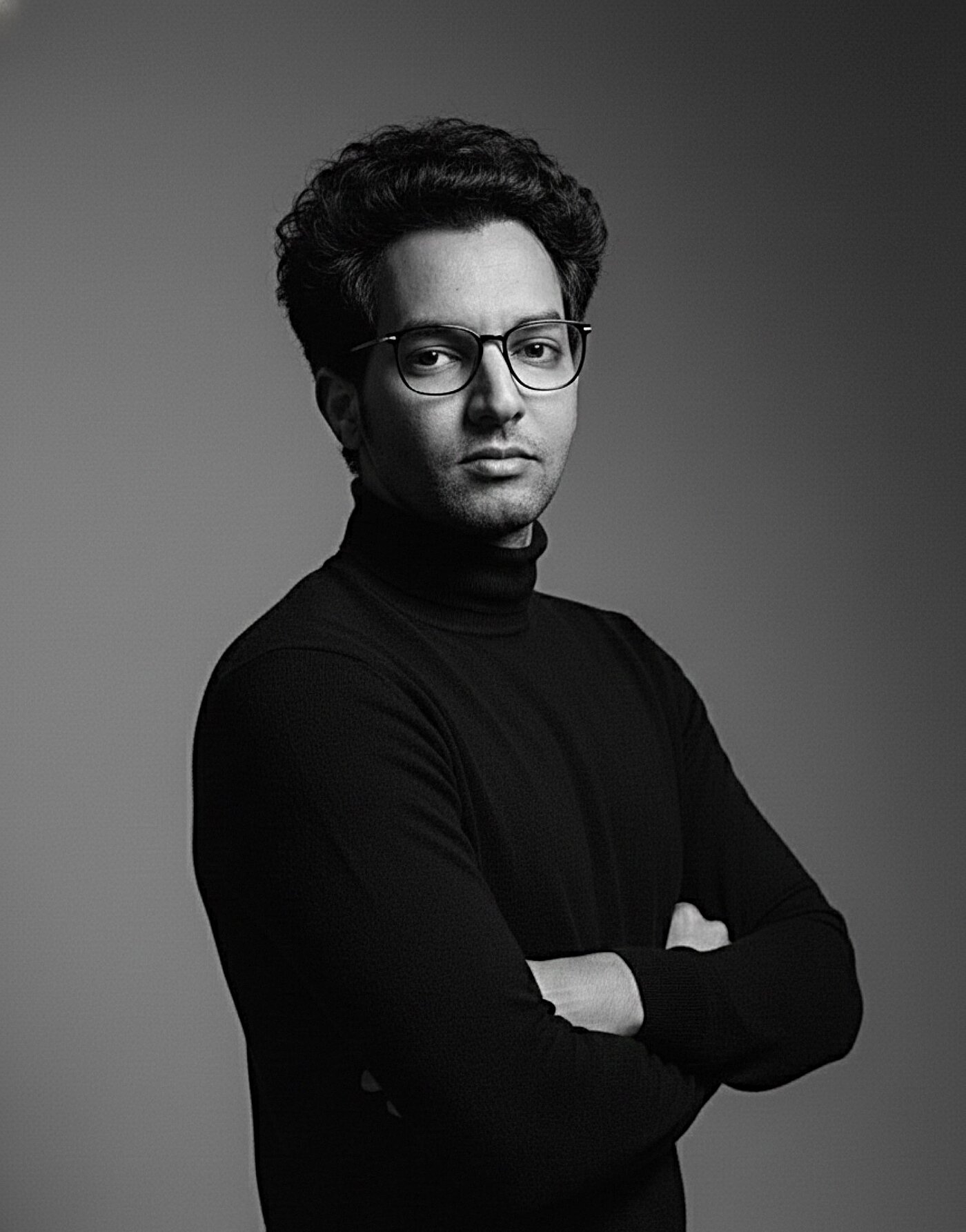
This year, the Palm Foundation is honouring a voice from exile. Yahya Ekhou now lives in Germany. In his homeland, Mauritania, he lost his freedom and his citizenship. The 13th Johann-Philipp-Palm-Award for Freedom of Expression and Freedom of the Press recognises his commitment. The Mauritanian lawyer and author shares the award. The second laureate is the Russian writer Natalya Klyucharyova. Both will receive 10,000 euros each. The award ceremony will take place on 29 November at the Barbara-Künkelin-Halle. The prize honours the memory of Johann Philipp Palm, a bookseller from Schorndorf. Napoleon had him executed in 1806. We spoke to Ekhou about his journey.
Mr Ekhou, you are to receive an award for freedom of speech in Schorndorf. Your journey to this point began far away from Germany. Where exactly does the story of this activist begin?
It begins where I was born. It begins with the family I grew up in. I am Arab and come from Mauritania. My family wielded considerable tribal and social influence. I did not grow up at the bottom of the social hierarchy. Because of my background, I belonged at the very top. This is important for understanding my journey. I did not discover social inequality as a lifelong burden. As a child, I studied religious texts and Arabic poetry. These were intended to prepare me for a leadership role within the tribe. I observed tribal relationships closely. I realised early on who had influence and who did not. Later, curiosity and doubt set in. I asked questions, particularly at secondary school. Why does one’s birth determine one’s place in society? Why does a tribal title count for more than a person? These questions became an integral part of my life.
You emphasise that you were at the top of this pyramid. Nevertheless, you questioned the whole system.
It is a system in which power is unevenly distributed. A small group at the top wields far greater influence. Below them lie various social classes, each with its own status. The problem is not that people are different. The problem is the permanence of this order. It determines value, status and rights from the moment of birth. You know in advance who will remain at the top. And you know who will remain at the bottom. That is not justice. I don’t simply want to replace the people at the top. I want to imagine a society without this pyramid.
Now, an unequal society is one thing. A state that upholds that inequality is another. You say that in Mauritania the two go hand in hand. How should I understand this relationship between tribe and state?
The tribal system is more powerful than state institutions. In short: the state is the tribe. And the tribe is the state. In the process, the rights of marginalised groups are lost. Mauritania is not made up of a single ethnic group. There are Arabs, Pular, Wolof, Soninke and Amazigh. Yet one ethnic group controls power, the economy, the army and religion. That group is the Arabs. This promotes the idea of a purely Arab Mauritania. But that is only part of the truth. There are many non-Arab sections of society.
You grew up in a world with fixed answers. Then you left Mauritania to study. In Cairo, you suddenly encountered ideas that were completely different. When did you start looking for your own answers?
In Nouakchott. I passed my A-levels with flying colours. This earned me a scholarship to study law. Cairo University has a renowned law faculty. There, a wide window onto the world opened up for me. In Mauritania, the range of books available was very limited. In Cairo, I read authors from all over the world. These included Nietzsche and Gustave Le Bon. I met people from many different countries. They thought in ways that were very different from my own. For me, this was a real liberation of thought. I discovered that a question can have many answers. Freedom begins with the mind. Those who hear only one opinion take it for the truth. Those who read many opinions are forced to think for themselves. I began to compare, to doubt and to ask questions. There are doubts that paralyse. And there are doubts that drive you on. Doubts drive me on.
You studied law in Cairo, not politics or philosophy. Many people regard law as a dry subject. For you, however, it became a driving force for resistance. How did that come about?
My studies changed the way I view society. I learnt that law and justice are not the same thing. There can be a law and yet no justice. A constitution may contain fine words about rights, but people cannot truly exercise those rights. That is the situation in Mauritania. This gradually led me to work in the field of human rights.
This realisation led you to take concrete action. You founded the Network of Liberals in Mauritania. The term ‘liberalism’ can easily be misunderstood in this context. What did you really hope to achieve with this platform?
I was convinced that society needs a genuine space for discussion. It is about freedom, minority rights and freedom of conscience. I wanted to create a space for dissent. No one should be regarded as an enemy simply because they think differently. For me, liberalism is not merely a slogan. Above all, it is the defence of human freedom. This includes the freedom to believe. And the freedom not to believe. I wanted to bring people together around this conviction. The state should not control people’s consciences. Rights do not come without a price. Hannah Arendt spoke of the right to have rights. That was precisely our aim. All Mauritanians should be equal before the law.
Your writings on the tribal system left you vulnerable. Ultimately, your ideas led to your imprisonment. How did you experience that time?
My focus was on the tribal system, which treats people unequally. For that, I was persecuted and arrested. I had to go to prison because of my ideas. There, I rediscovered the value of freedom. When you’re free, you rarely think about simple things. You open a door and go wherever you like. You read and write whatever you like. In prison, such things become symbols. I didn’t give up my convictions whilst I was there. On the contrary: they grew stronger. Human rights are not just words. You have to defend them, even at a high price.
The state also stripped you of your citizenship. For some people, that is merely an administrative procedure. For you, it was clearly more than that. How did this revocation affect you?
It was one of the most painful experiences of my life. Citizenship is more than just a document. It is a sense of belonging. Revoking it as a punishment says: ‘You no longer belong here.’ The state can take my passport away. It cannot take my memories. Nor can it take my childhood or my language. I lose my citizenship, but not my roots.
Without a passport and without protection, staying was impossible. In 2018, you had to leave your homeland. Today you live in Germany, far away from everything familiar. How does this exile feel to you?
For me, exile begins with a farewell. I didn’t just leave a country behind. I left a part of my life behind. I often think of my mother’s fish and rice dish. Even its scent meant ‘home’ to me. I think of riding a camel in the desert. I think of the nights under a clear sky. It was only from a distance that I understood the value of these moments. One thing weighs heaviest of all. I cannot visit my mother’s grave. This distance is more than just a matter of kilometres. Today I live in Germany. I am grateful for the safety here. Nevertheless, a part of me has remained in Mauritania. I can love my country and criticise it at the same time. My criticism does not stem from hatred. It stems from the hope for improvement. I left Mauritania. But Mauritania has not left me.
Your story sounds very much like Mauritania. Yet much of it is reminiscent of other countries. It brings to mind the concentration of power, persecution and oppressed minorities. Is Mauritania really an exceptional case?
No. Mauritania simply receives little international attention. In many countries, power lies with a small group. Sometimes it is an ethnic group, sometimes the army. In Mauritania, religious and social influence come into play as well. The real question extends beyond the country itself. What happens when a small group demands more rights? This question affects many societies.
After all that, you could have fallen silent. Instead, you write about others whom hardly anyone hears. Your focus is on the invisible members of society. Why is this in particular so important to you?
I have seen how a dictatorship renders people invisible. A single word can land you in prison. A person becomes nothing more than a category. They are regarded as a class, a tribe, a religion or a gender. Yet behind each of these words stands a human being. A human being with a name, a history and dignity. Through my writing, I place these people at the centre. I don’t just want to talk about people. I want to be their voice.
You embody two roles at once. The activist wants to bring about change; the author wants to understand. These can also contradict one another. How do you bring both sides together in your books?
The two are inseparable. The activist says: ‘This is unjust.’ The author asks: ‘How did this injustice come about?’ This is evident in both my books. In *Free People Cannot Be Tamed*, I denounce the circumstances. I want to encourage readers to think for themselves and to rethink their views. In *Voices from the Silence*, I give women a voice. They are oppressed women with a longing for education and freedom. I want to bring their hidden plight to light. And I want to show a way out of oppression. The activist wants change. The writer wants to understand. I need both. I don’t want the reader to simply agree with me. I want him to think.
You once made a powerful statement: that the power of words can overcome the power of bullets. That is a bold claim in the face of real violence. Where does this conviction come from?
A bullet can kill a person. A prison can confine a body. The state can revoke citizenship. But it cannot so easily capture a thought. In Cairo, I read authors I had never met. Some were thousands of kilometres away. Some had long since died. Yet their ideas reached me. That taught me this: ideas know no boundaries. In dictatorships, words can outweigh bullets. Persecution silences people. But a single text can make a thousand others speak out.
Finally, perhaps the simplest and yet the most difficult question. You have paid a high price for your words. Yet you carry on writing, day after day. Why do you do that?
I know from my own experience what a book can achieve. Very few Mauritanians write about the situation in the country. I share in this responsibility. I want to convey the voice of the Mauritanian people to the world. A writer can open a window in a closed wall. Sometimes change begins with a single courageous sentence. Namely, that all people have equal rights.
About the person
Yahya Ekhou was born in Mauritania in 1990. He is a lawyer and author. He grew up in a tribal society characterised by Sunni Islam. He was destined to become a tribal leader. His law studies took him to Cairo. He later founded the Network of Liberals in Mauritania. Because of his activism, he was persecuted and imprisoned. He also lost his citizenship. In 2018, he fled to Germany. Today, he is chairman of Secular Refugee Aid Germany. He is also a founding member of the Working Group on Political Islam. He opposes the punishment of apostasy. He advocates for secular refugees. He has published two books. ‘Free People Cannot Be Tamed’ was published in 2022. ‘Voices from the Silence’ followed in 2025. He shares the 2026 Palm Prize with Natalja Kljutscharjowa. Both will receive 10,000 euros each. The award ceremony will take place on 29 November 2026 in Schorndorf.